

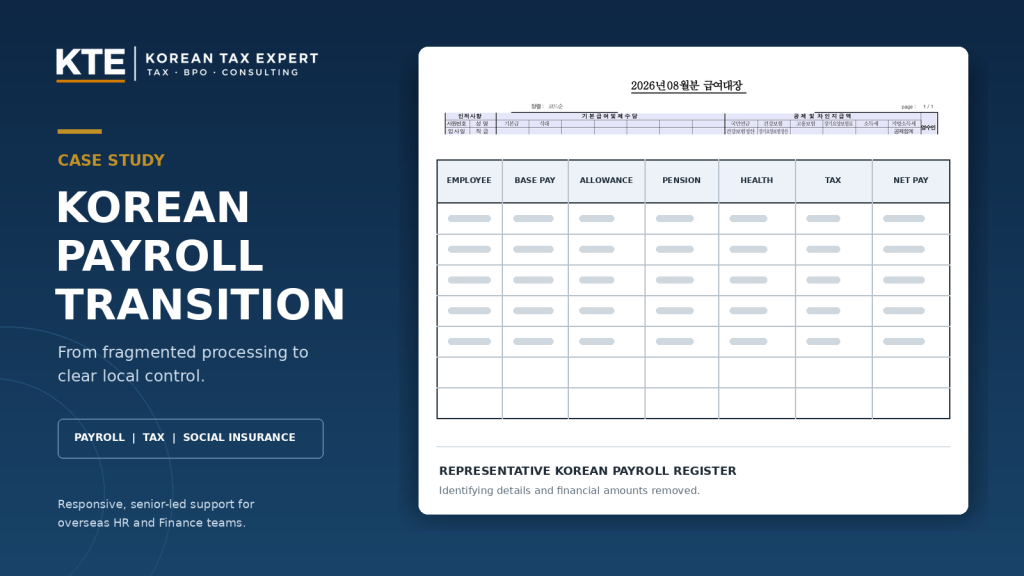
To protect client confidentiality, identifying details and non-essential facts have been generalised.
A foreign-invested industrial equipment company in Korea needed more than a new payroll calculation provider. It needed a responsive local team that could complete a controlled transition, understand a complex workforce and remain directly involved when exceptional payroll and employment issues arose.
The company had previously used a large global professional-services provider. As its Korean payroll became more complex, overseas headquarters and local management wanted clearer ownership, faster issue resolution and greater continuity from experienced professionals.
STAR TAX & BPO completed the handover, stabilized the monthly payroll process and has continued to support the company on a long-term basis.
Case at a Glance
- Business: Foreign-invested industrial equipment company in Korea
- Workforce: Approximately 100 employees
- Payroll profile: Korean and foreign employees, fixed-term staff, complex bonus arrangements and non-standard working patterns
- Initial requirement: A controlled transition from a large global provider
- Ongoing requirement: Direct senior support, prompt responses and practical advice on difficult payroll matters
- Additional challenge: Payroll and employment-record support during a labor inspection
Why the Client Changed Payroll Providers
The client was not simply looking for a lower-cost calculation service. Its overseas HR and Finance teams needed a Korean payroll partner that could:
- communicate directly in English without repeated internal handoffs;
- explain Korean payroll, withholding tax and social insurance requirements in practical terms;
- take ownership of the local payroll timetable and follow-up items;
- respond promptly when exceptional employee matters arose;
- coordinate employee changes, payroll inputs, filings and payment information; and
- identify issues early enough for management to make an informed decision.
The concern was not limited to whether the final net-pay figures were mathematically correct. Management also needed to know who was responsible for each step, what information remained outstanding and whether a payroll decision could affect Korean tax, social insurance or employment administration.
Challenge 1: Reconstructing the Year-to-Date Payroll Position
A mid-year payroll transition requires more than employee names and current monthly salaries. Payroll history is connected to withholding tax, local income tax, social insurance, year-end tax settlement, severance, employee changes and foreign-employee matters.
The handover therefore required a structured review of:
- employee master data, employment dates and contractual terms;
- recurring and variable compensation;
- taxable and non-taxable allowances;
- year-to-date gross pay and income tax already withheld;
- local income tax and social insurance records;
- foreign-employee tax and social insurance positions;
- severance or retirement-plan information;
- prior corrections and unresolved items; and
- information required for year-end tax settlement.
A single summary file could not show whether all figures agreed with the surrounding tax and social-insurance records. The transition had to be treated as a reconciliation project rather than a simple file transfer.
Challenge 2: Managing a Complex Workforce
This was not a routine payroll consisting only of fixed monthly salaries. The workforce included a significant number of foreign employees and fixed-term staff, while compensation and working arrangements differed across employee groups.
The monthly process required careful treatment of:
- different employment terms and contract periods;
- complex bonus calculations and payment timing;
- employee groups with different working arrangements;
- foreign-employee social-insurance and payroll considerations;
- joiners, leavers and retrospective payroll changes; and
- coordination between Korean management and overseas stakeholders.
In this environment, a delayed answer or an assumption based on a standard payroll model could create further questions for employees, management and headquarters.
Challenge 3: Protecting the Monthly Timetable and Clarifying Responsibility
Payroll could not pause while the handover was being completed. Employee inputs, approval dates, payslips, salary payments, withholding obligations and social-insurance reporting continued according to their normal timetable.
At the same time, questions could no longer be allowed to pass through several teams before reaching someone familiar with the Korean issue. A bonus, new hire, unpaid-leave period, employee departure or overseas payment can affect more than one part of the payroll process.
The client needed one responsive local point of contact who could see the full workflow, distinguish first-payroll priorities from historical follow-up items and explain what action was required from headquarters.
How STAR TAX & BPO Responded
- Defined the cutover scope and responsibilities. We prepared a practical handover map covering the former provider, overseas headquarters, the Korean entity and our team.
- Issued a structured handover request. The request covered employee, payroll, tax and social-insurance records rather than only the latest payroll register.
- Reconciled the year-to-date position. We reviewed the opening information and identified items requiring clarification before they were carried into the new process.
- Established a bilingual monthly calendar. Headquarters received a clear timetable for inputs, draft review, approval, payslips, filings and payment information.
- Stabilized the recurring payroll process. Monthly calculations, employee changes, bonuses, retrospective adjustments and foreign-employee issues were brought into a consistent workflow.
- Provided direct senior involvement. Complex questions were reviewed by professionals familiar with Korean payroll, tax and social-insurance practice.
- Documented exceptions and follow-up items. Unusual employee arrangements and unresolved historical points were tracked separately so they would not disappear into the monthly routine.
Supporting the Company During a Labor Inspection
The company later underwent a labor inspection involving its employment and payroll arrangements. The matter required a careful review of payroll records, compensation items, employment terms and working patterns.
STAR TAX & BPO helped organize the relevant payroll information, reviewed the issues raised and supported the company in preparing practical and consistent responses. The process was concluded without material payroll-related financial loss or operational disruption to the company.
This experience demonstrated the importance of maintaining payroll records that can be explained not only during the monthly cycle, but also when a regulator asks how compensation and working arrangements have been applied.
The Ongoing Result
Following the transition, the company’s payroll has been managed on a stable ongoing basis. Complex bonus changes, foreign-employee questions and non-standard working arrangements are addressed promptly, while overseas headquarters and local management receive practical guidance on the available options.
The continuing relationship reflects what many foreign-invested companies value in a boutique provider:
- continuity of experienced personnel;
- fast and direct communication;
- practical recommendations based on hands-on payroll experience;
- coordination across payroll, social insurance, tax and employee changes; and
- a reliable monthly process combined with support for exceptional issues.
What Foreign Employers Can Learn from This Case
- A payroll transition is a compliance handover. Current net pay alone is not enough; the new provider needs the history behind the figures.
- Responsiveness is a control. A delayed answer can affect payroll approval, employee communication, filing or payment timing.
- Complex workforces require contextual review. Foreign employees, fixed-term contracts, unusual working patterns and complex bonuses may not fit a standard payroll template.
- Define responsibility before the first live payroll. Clarify who provides inputs, approves calculations, makes payments and handles follow-up matters.
- Senior local involvement matters. Korean payroll decisions often sit across tax, social insurance, employment administration and finance operations.
- Good records matter beyond the monthly cycle. Payroll information must also be explainable during year-end settlement, employee exits and regulatory reviews.
How We Support Korean Payroll
STAR TAX & BPO supports foreign-invested companies that are establishing their first Korean payroll, replacing an existing provider or managing a complex employee population under clearer local control.
Our support can include payroll calculation, payslips, withholding tax, social-insurance administration, year-end tax settlement, expatriate and foreign-employee matters, severance and retirement processes, payment administration and English reporting to overseas headquarters.
Learn more about our CPA-led payroll services in Korea.
If your company is considering a Korean payroll transition or needs support with a complex workforce, use our service inquiry form. Email-first inquiries are welcome, and we aim to reply within one Korean business day.
Important Notice
This case study is provided for general information and does not constitute tax, labour-law or legal advice. Certain facts have been generalised to protect the client’s identity. The correct payroll process depends on the employer’s workforce, payroll history, social-insurance status, compensation arrangements and agreed service scope.
